
Blown fuse. Tripped breaker. A dead power tool right in the middle of a project.
If you’ve ever worked on electrical equipment or home wiring, you’ve probably run into one of these problems. Often, the cause isn’t faulty equipment. It could be attributed to a misuse of Ohm’s Law.
For those interested in learning the basics of electrical wiring, understanding Ohm’s Law is a great place to start. It helps electricians, engineers, and DIYers calculate voltage, current, and resistance so circuits operate safely. When you understand how these values work together, you can prevent blown fuses and avoid dangerous wiring mistakes.
In this guide, we provide a preview of what students will learn in Erie Institute of Technology (EIT)’s Electrician Training Program. Read on to learn:
- What Ohm’s Law is and how it works
- The relationship between voltage, current, and resistance
- How to use the formula for real electrical calculations
- How electricians use Ohm’s Law to prevent overloaded circuits
- A simple project to apply the formula yourself
What Is Ohm’s Law and Why Does Every DIYer Need to Know It?
For beginners trying to understand how electricity works, Ohm’s Law provides the foundation for everything that comes next in EIT’s Electrician Training Program.
The law was discovered in 1827 by German physicist Georg Simon Ohm, who observed that the electric current flowing through a conductor is directly proportional to the voltage and inversely proportional to the resistance.
The relationship is expressed as:
This simple equation allows electricians to calculate unknown values in a circuit and determine whether a system will operate safely.
| Formula | Meaning |
| V = I × R | Voltage (V) equals current (I) multiplied by resistance (R) |
This simple equation allows electricians to calculate unknown values in a circuit and determine whether a system will operate safely.
Without these calculations, circuits can easily overload. According to the National Fire Protection Association (NFPA), overloaded circuits and improper wiring practices cause tens of thousands of residential fires each year in the United States.
When electricians understand Ohm’s Law, they can:
- Calculate the current a circuit will carry
- Select the correct fuse or breaker size
- Choose a wire capable of handling the load
- Diagnose electrical problems quickly
- Prevent dangerous electrical hazards
Understanding Voltage, Current, and Resistance
Ohm’s Law describes the relationship between three core electrical values:
- Voltage (V) – the electrical pressure pushing current through a circuit
- Current (I) – the flow of electrical charge
- Resistance (R) – the opposition to that flow
Think of electricity like water flowing through a pipe. This analogy helps simplify how circuits behave.
| Electrical Term | Symbol | Water Analogy | What It Means |
| Voltage | V | Water pressure | The force pushing electricity through a circuit |
| Current | I | Flow of water | The amount of electricity moving through the wire |
| Resistance | R | Pipe restriction | Anything that slows electrical flow |
Voltage: The Electrical Push
Voltage is the force that drives electricity through a circuit. It is measured in volts (V) using a device called a multimeter. In homes across the United States, outlets typically provide 120 volts.
Current: The Flow of Electricity
Current is the amount of electricity moving through a wire and is measured in amperes (amps).
For example:
- A small LED light may draw 0.02 amps
- A handheld power drill may draw 6–8 amps
- A space heater may draw 12–15 amps
When current exceeds what a circuit is designed to carry, protective devices like fuses and breakers trip to prevent overheating and fires.
Resistance: The Opposition to Electrical Flow
Resistance slows the movement of electrical current and is measured in ohms (Ω). Every electrical component, from light bulbs to heating elements and motors, generates some amount of resistance.
The Ohm’s Law Formula Explained
Now that you understand the three variables, the Ohm’s Law formula becomes easier to rearrange and solve for any value you need before installing electrical equipment.
The Ohm’s Law Triangle Trick
Many electricians memorize the formula using the Ohm’s Law triangle. Imagine a triangle divided into three sections. To calculate a value, cover the value you want to find and the remaining values show the equation.
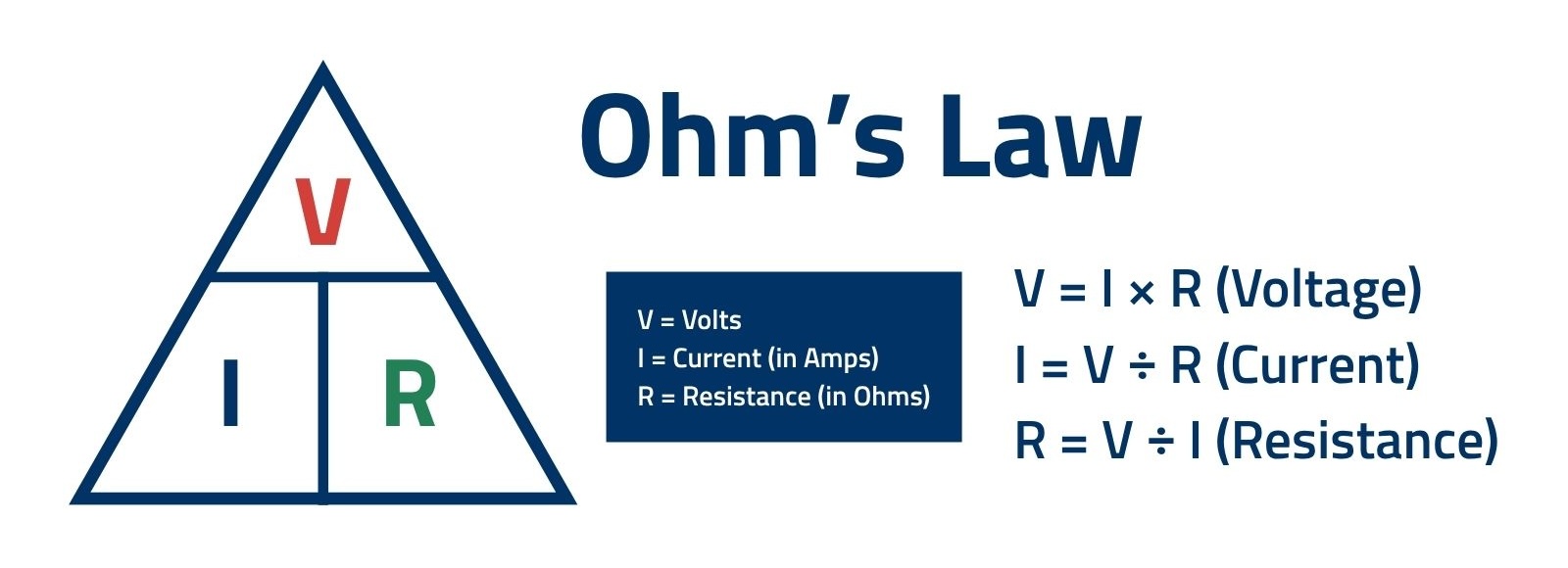
Examples:
Find Current
Voltage = 120V
Resistance = 20Ω
I = 120 ÷ 20
I = 6 amps
Find Resistance
Voltage = 9V
Current = 0.03A
R = 9 ÷ 0.03
R = 300Ω
Real-World Applications: From Light Bulbs to Power Tools
Ohm’s Law is a formula you’ll take with you everywhere once you leave the classroom. Understanding these calculations is essential when working with wiring systems such as HVAC electrical components, where improper loads can damage compressors, motors, or circuit boards.
Let’s look at how it works in real situations.
Example: Calculating Current for a Device
Suppose you have a device that operates at 120 volts with a resistance of 20 ohms.
Using Ohm’s Law:
I = V ÷ R
I = 120 ÷ 20
I = 6 amps
This means the device draws 6 amps of current from the circuit, which helps electricians determine whether a circuit can safely handle the load and what size breaker is required.
Common Household Electrical Loads
| Device | Typical Voltage | Typical Current |
| LED light bulb | 120V | 0.02A |
| Laptop charger | 120V | 1–2A |
| Power drill | 120V | 6–8A |
| Microwave oven | 120V | 10–12A |
| Space heater | 120V | 12–15A |
| Breaker Size | Maximum Safe Wattage |
| 15 amp | 1,800 watts |
| 20 amp | 2,400 watts |
When too many devices draw power from the same circuit, the current rises above the safe limit and the breaker trips to prevent overheating.
Safety First: How Ohm’s Law Prevents Electrical Disasters
Electrical safety is one of the biggest reasons professionals rely on Ohm’s Law. Understanding resistance and current allows electricians to calculate the expected current before connecting equipment, preventing these common electrical hazards:
- Too many devices on one circuit
- Undersized wiring
- Short circuits
- Damaged insulation
- Faulty appliances
Basic Electrical Safety Checklist
- Turn off the power before working on circuits
- Use a multimeter to verify voltage
- Check wire ratings before adding loads
- Use properly sized fuses or breakers
- Inspect connections for damage or corrosion
Troubleshooting Like a Pro: Using Ohm’s Law to Diagnose Problems
When a circuit stops working, Ohm’s Law can often reveal the problem. Electricians frequently use these methods when troubleshooting HVAC systems, including motors, appliances, and control systems.
Common Electrical Faults
| Problem | What Happens | Diagnosis |
| Short circuit | Resistance drops extremely low | Current spikes |
| Open circuit | Resistance becomes extremely high | Current stops |
| High resistance connection | Loose wire or corrosion | Voltage drop |
Basic Troubleshooting Process
- Measure voltage at the source
- Check resistance across components
- Calculate the expected current using Ohm’s Law
- Compare measured current with expected values
- Identify where the circuit behavior changes
Your First Ohm’s Law Project: LED Circuit Calculation
One of the easiest ways to see Ohm’s Law in action is to build a simple LED circuit.
Materials Needed
- 9-volt battery
- LED
- Resistor
- Breadboard
- Jumper wires
Step-by-Step Calculation
Suppose an LED requires:
- 2 volts
- 20 milliamps (0.02 amps)
Battery voltage: 9 volts
Using Ohm’s Law:
R = (Vsource − VLED) ÷ I
R = (9 − 2) ÷ 0.02
R = 350 ohms
The closest standard resistor value is 360 ohms.
Assembly Steps
- Connect the resistor to the LED’s positive lead.
- Attach the resistor to the battery’s positive terminal.
- Connect the LED’s negative lead to the battery’s negative terminal.
- Turn on the power and observe the LED illuminate.
Hands-on exercises like this are exactly how aspiring electricians begin building their skillsets, demonstrating how simple electrical calculations protect components from damage.
Start Your Electrical Career at Erie Institute of Technology
Interested in becoming an electrician? Understanding Ohm’s Law is just the beginning.
If you enjoy solving problems and working with technology, EIT’s Electrician Training Program can lead to a rewarding career. Students receive hands-on instruction in:
- Electrical theory and circuit analysis
- Residential and commercial wiring
- Electrical troubleshooting
- Safety procedures and code compliance
If you’re ready to take the next step, explore how you can become an electrician and start building practical skills for the electrical industry. Schedule a tour or apply online today.
About Author:

Ross Aresco
CFO
Ross Aresco is the CFO of Erie Institute of Technology. Erie Institute of Technology (EIT) is an Erie Pennsylvania technical/trade school providing training programs for medical, computer, electronics, manufacturing, and technology careers. EIT offers programs in many different areas to suit your interests and talents.