
From residential service calls to large commercial job sites, electricians work in environments where safety is non-negotiable. For trade school students and apprentices, learning to identify, evaluate, and control these risks is critical to developing safe work habits that last throughout your career.
This electrician safety guide breaks down the most common electrical hazards that electricians face, explains why they are dangerous, and outlines proven prevention strategies used across the industry. Understanding these risks is not just about compliance. It is about protecting your health, your coworkers, and your future in the electrical trade.
Why Electrical Safety Training Matters
According to the Occupational Safety and Health Administration (OSHA), electrocution remains one of the leading causes of fatalities in the construction industry, alongside falls and struck-by incidents. Many of these accidents happen because hazards were overlooked, misunderstood, or improperly controlled.
Proper safety training helps electricians:
- Recognize common electrical hazards before work begins
- Follow OSHA electrical standards correctly
- Use tools, protective equipment, and procedures the right way
- Reduce the risk of serious injury, fire, or fatal accidents
The hazards below represent some of the most common and dangerous risks electricians encounter, along with practical ways to reduce exposure:
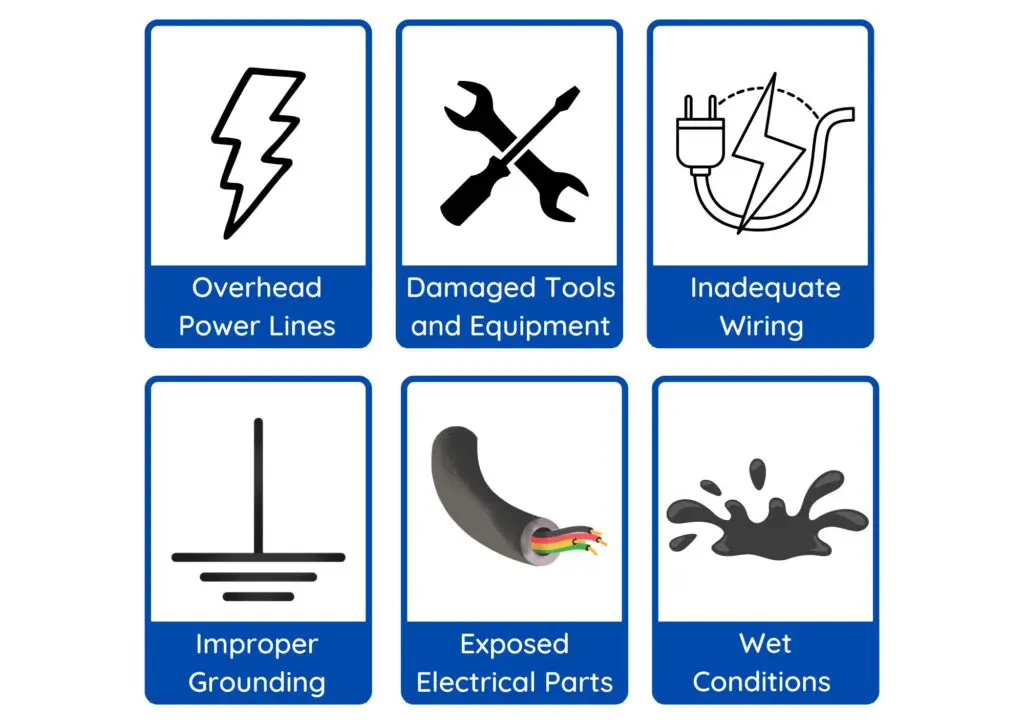
1. Overhead Power Lines: The Leading Cause of Fatalities
Contact with overhead power lines often results in severe burns, electrocution, or death. These incidents commonly occur when ladders, scaffolding, lifts, or long tools are raised too close to live lines.
Power lines may appear insulated or inactive, but often carry high voltage at all times. Even indirect contact can cause electricity to arc through the air to nearby equipment or workers.
How to reduce the risk:
- Always assume overhead lines are energized
- Maintain safe clearance distances as required by OSHA
- Use non-conductive ladders and tools
- Clearly mark and barricade areas near overhead lines
- Coordinate with utility companies when work must be performed nearby
Key Lesson: Understanding how electricity travels and maintaining constant situational awareness are key components of electrician safety.
2. Damaged Tools and Equipment
Using damaged electrical tools or equipment significantly increases the risk of shocks, burns, and fires. Cracked insulation, exposed wiring, broken plugs, and worn cords can allow current to escape and energize surfaces that should be safe to touch.
Common warning signs:
- Frayed or cracked cords
- Loose connections or plugs
- Overheating tools
- Tripped breakers during tool use
How to reduce the risk:
- Inspect tools before every use
- Remove damaged equipment from service immediately
- Follow manufacturer maintenance guidelines
- Use tools rated for the environment and voltage level
Key Lesson: Routine inspections are a simple yet effective way to prevent injuries caused by faulty equipment.
3. Inadequate Wiring and Overloaded Circuits
Improper wiring and overloaded circuits are major contributors to electrical fires and equipment damage. Over time, heat can build up and damage insulation, ignite surrounding materials, or cause system failure.
This hazard is especially common during renovations, temporary power setups, or older buildings with outdated electrical systems.
How to reduce the risk:
- Follow load calculations and code requirements
- Never bypass circuit protection devices
- Use correctly rated wiring and components
- Identify signs of overload, such as flickering lights or warm outlets
Key Lesson: Learning how to properly design, install, and evaluate electrical systems is essential for preventing overload-related hazards.
4. Improper Grounding
When electrical systems or equipment are not grounded correctly, electricity can travel through unintended paths, including a worker’s body. This greatly increases the risk of electric shock or electrocution.
Improper grounding often occurs due to installation errors, damaged grounding conductors, or outdated electrical systems that no longer meet current OSHA electrical standards.
How to reduce the risk:
- Verify that all systems and equipment are properly grounded
- Inspect grounding conductors regularly for damage or corrosion
- Follow code requirements during installation and repairs
- Use grounding tools and testers to confirm continuity
Key Lesson: Understanding grounding principles is a foundational part of electrician safety and a skill reinforced through hands-on training.
5. Exposed Electrical Parts
Exposed electrical parts, such as uncovered terminals, live wires, or open panels, create a serious shock and burn hazard. These dangers are often present during maintenance or when protective covers are removed without being replaced.
How to reduce the risk:
- De-energize circuits before working whenever possible
- Replace covers and guards immediately after work is complete
- Clearly label energized components
- Maintain safe working distances from live parts
Key Lesson: Recognizing exposed electrical hazards and following safe work practices are essential electrician safety tips taught early on in trade education programs.
6. Wet Conditions and Moisture
Water and electricity are a dangerous combination. Wet conditions increase conductivity, making it easier for electrical current to pass through the body. Electricians frequently encounter moisture when working outdoors, in basements, near plumbing systems, or during inclement weather..
How to reduce the risk:
- Avoid working with electrical equipment in wet conditions whenever possible
- Use equipment rated for damp or wet locations
- Wear appropriate electrical PPE designed to resist moisture
- Install and test Ground Fault Circuit Interrupters (GFCI)
Key Lesson: Managing moisture exposure is a critical component of job site safety and electrical hazard prevention.
Understanding the Danger of Arc Flash and Arc Blast
An arc flash occurs when electrical current jumps through the air between conductors or from a conductor to the ground. This sudden release of energy creates extreme heat, intense light, and molten metal, often reaching temperatures hotter than the surface of the sun.
An arc blast is the pressure wave that follows an arc flash. It can send shrapnel flying, knock workers off ladders, and cause serious physical trauma. Reducing arc flash risk requires proper system design, hazard analysis, labeling, and the use of appropriate arc flash protection and PPE.
Why arc flash protection matters:
- Severe burns can occur, even without direct contact
- Hearing damage and vision loss are common
- Clothing can ignite instantly
Essential Protective Measures: Lockout/Tagout (LOTO)
Lockout/tagout procedures (LOTO) are designed to protect workers from the accidental startup or release of stored energy during maintenance or repair work, ensuring that electrical systems remain de-energized until work is complete.
LOTO is a learned skill that requires training, repetition, and strict adherence to established procedures. When applied correctly, it is one of the most effective preventative safety measures.
Why LOTO is critical:
- Prevents unexpected energization
- Reduces fatal and severe injury risks
- Reinforces accountability on job sites
Essential Electrical Safety Devices
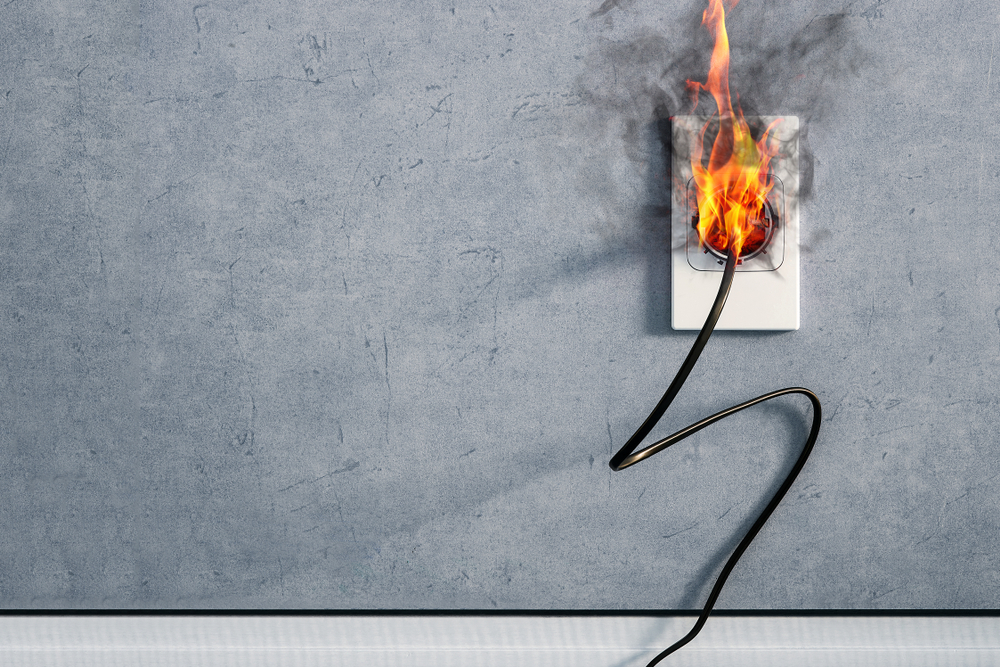
Electrical safety devices are designed to detect dangerous conditions and interrupt power before injuries or damage occur. Understanding how they work is essential to electrician training and self-protection in the field.
Examples of electrical safety devices include:
- Circuit breakers and fuses
These devices protect electrical systems from overloads and short circuits. When excessive current flows, breakers trip or fuses blow to stop power and prevent overheating or fires. - Ground Fault Circuit Interrupters (GFCI)
GFCIs monitor the flow of electricity and shut off power when a ground fault is detected. They are especially important in wet or damp locations, such as bathrooms, kitchens, and outdoor areas, where the risk of shock is higher. - Arc Fault Circuit Interrupters (AFCI)
AFCIs are designed to detect dangerous arcing conditions that standard breakers may not catch. By interrupting power when arcing is detected, these devices help reduce the risk of electrical fires and support arc flash protection efforts. - Voltage testers and multimeters
These tools measure voltage, current, and resistance, allowing electricians to verify whether circuits are energized. Using testers before beginning work is a fundamental safety practice for electricians. - Surge protectors
Surge protectors help safeguard equipment from voltage spikes caused by lightning, power fluctuations, or switching operations. While they do not replace proper grounding or circuit protection, they add an extra layer of defense. - Insulated tools
Tools rated for electrical work reduce the chance of accidental contact with live components. Proper tool selection is essential when working near energized systems.
Necessary Types of Personal Protective Equipment (PPE)
Personal protective equipment (PPE) is the final barrier between electricians and electrical hazards. While electrical PPE should never replace safe work practices, it plays a critical role in reducing injury severity when hazards cannot be fully eliminated.
Head and Eye Protection
Head and eye injuries are common during electrical work, especially when dealing with arc flash hazards or overhead installations.
- Hard hats protect against impact and flying debris
- Safety glasses and face shields protect against sparks, arcs, and debris
- Arc-rated face shields provide added protection during high-risk tasks
Hand and Arm Protection
Hands and arms are frequently exposed during electrical tasks. Without proper protection, contact with energized components can result in severe burns or shocks.
- Insulated gloves rated for the appropriate voltage
- Leather protectors worn over rubber gloves
- Arc-rated sleeves for added coverage
Body and Footwear
Full-body protection helps reduce the impact of arc flash events and other electrical incidents.
- Arc-rated clothing designed to resist ignition
- Flame-resistant materials that reduce burn severity
- Electrical hazard-rated footwear to prevent current flow through the body
How Trade Schools Prepare You for These Hazards
For students and apprentices, structured education provides a controlled environment where you can learn electrician safety tips before stepping onto active job sites. Trade schools provide hands-on training that teaches students how to identify hazards, follow safety procedures, and apply industry standards.
Erie Institute of Technology’s Electrician Training Program prepares students to apply OSHA electrical standards, use safety devices properly, and follow lockout/tagout procedures. Training emphasizes hazard recognition and safe tool use.
Students also receive guidance on certifications and safety credentials to help them prepare for entry-level roles and long-term career growth. Financial support options, including financial aid, can make career training more accessible.
Ready to Work Safely? Start Your Electrical Education at EIT Today
Understanding electrical hazards and knowing how to control them is a skill set that electricians rely on every day. From recognizing overhead power line dangers to using proper electrical PPE, safe work practices protect lives and careers.
EIT’s formal vocational training programs provide the foundation for working confidently and safely in real-world environments. Through structured instruction, hands-on lab experience, and safety-focused education, we help future electricians build smart habits from day one so they stand out to future employers.
Apply online and take the next step toward a safer, more prepared future in the electrical trade.
About Author:

Ross Aresco
CFO
Ross Aresco is the CFO of Erie Institute of Technology. Erie Institute of Technology (EIT) is an Erie Pennsylvania technical/trade school providing training programs for medical, computer, electronics, manufacturing, and technology careers. EIT offers programs in many different areas to suit your interests and talents.